
Let’s talk a bit about web browsers. Today web surfing is an integral part of life and, at the same time, a favorite pastime of millions of people. Based on this statement, we can say that web browsers are among the most popular programs today.
Preview author: 200degrees
The web browser market today offers a huge selection of programs for viewing internet content, but that’s only at first glance. In reality, most browsers share the same foundation — the Chromium browser, running on the Blink engine.
🖐️Hey!
Subscribe to our Telegram channel @r4ven_me📱, so you don’t miss new posts on the website 😉. If you have questions or just want to chat about the topic, feel free to join the Raven chat at @r4ven_me_chat🧐.
Here’s a short list of popular browsers running on this engine:
- Chrome
- Microsoft Edge
- Chromium
- Yandex Browser
- Opera
- Vivaldi
- Brave
And others.
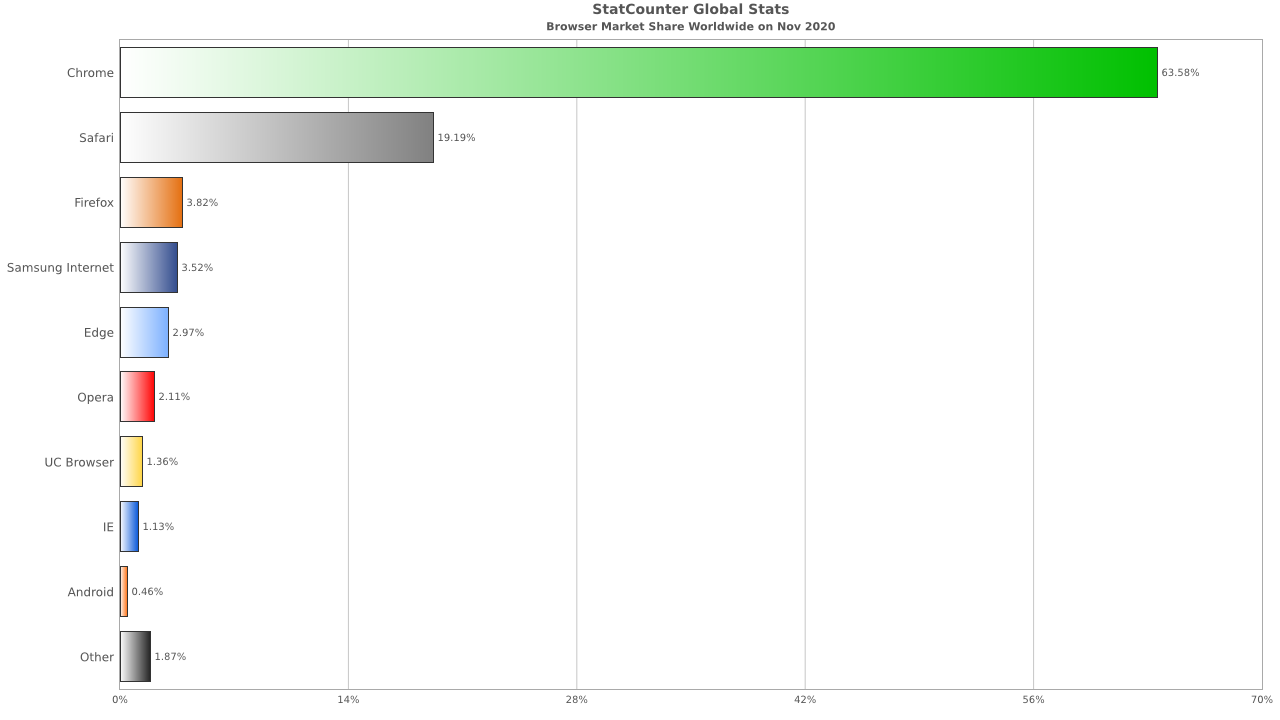
A few charts and graphs about the popularity of web browsers worldwide:
Source: statcounter.com

Source: statcounter.com
As you can see, the Chrome browser, which is based on the aforementioned Chromium, holds the leading position by an incredible margin. And considering that many other browsers are also based on the same Chromium, the gap is even larger.

Author: Lumapoche
The difference between the Chrome browser and Chromium is that Chrome is a purely commercial product from Google, which includes proprietary components and is licensed as free-of-charge software, but not open-source.
As for the Chromium browser, it has fully open source code and is distributed under free licenses: Apache, BSD, MIT, LGPL, and others.
It’s precisely because the browser’s code is open to anyone that it has spawned so many clones with extended functionality, specific to each individual developer.
It’s important to note that although the browser has open source code and free licenses, it’s not without flaws in the form of telemetry from Google itself. That is, while using it, certain usage statistics are collected in the background and regularly sent to Google’s servers. This fact was established as soon as the public began studying the program’s source code.
For this reason, a project called Ungoogled-Chromium appeared — a version of the Chromium browser completely stripped of Google telemetry.
By the way, the Chrome browser has gone much further in terms of collecting and sending telemetry. It’s impossible to fully find out exactly what it collects, since some components of this browser are closed and not available for users to study.
If you’re an avid user of the Yandex browser, it’s probably better you don’t know how much telemetry it collects. From the standpoint of open-source software ethics, whose ideology is practicality, usefulness, and privacy toward the user, the browser from Yandex is nothing but a commercial spawn of hell 🙂

Author: geralt
Second in popularity worldwide (but not in the CIS countries — 3rd place) is the browser from Apple — Safari. This browser also has closed components and a proprietary license. Safari is based on the free web page rendering engine WebKit, developed by Apple itself. By the way, the Blink engine, on which the Chromium browser is developed, is also based on the free WebKit.
I agree, it all looks quite convoluted, but that’s the power of open-source software. The developments that have shown the greatest practical benefit form the basis of software solutions from other developers, saving a huge amount of time on creating and adding new features instead of reinventing the wheel for the hundredth time.

Author: geralt
3rd place on our list goes to the cunning fox — the Firefox browser. This browser is fundamentally different from its peers, primarily due to its use of its own page rendering engine Quantum, which in turn is based on the Gecko and Servo engines, developed by Mozilla itself.
The source code of the Firefox browser is completely open, meaning it has no closed components, which is important, and it’s distributed under free licenses: GPL/LGPL/MPL.
It’s fair to note that although Firefox is completely open-source software, it’s not without the drawbacks of fully commercial products such as Chrome or Safari. Namely, this browser also collects telemetry, albeit in significantly smaller amounts than its competitors. Although it does have the option to disable data collection, there’s no way to be 100% sure that it doesn’t collect anything else.

Author: skylarvision
Nevertheless, this browser is the preferred option for people who care about at least partially preserving their own privacy on the internet. So to speak, the lesser of two evils.
I personally use Firefox for my travels across the vast expanses of the internet and can confidently recommend it to others. It supports a wide range of extensions, has the minimally necessary customization options, and an acceptable performance speed. And, of course, it respects the privacy of its users, although not 100% :(. The browser regularly receives updates and various innovations. It also has a long-term support edition — ESR releases, for those for whom the stability and consistency of the browser environment matter. Such versions of the fire-fox are used mainly in organizations and receive only security updates with fixes for critical vulnerabilities.
An interesting fact about the Mozilla Firefox logo. Everyone always identifies the animal on the company’s logo as a red fox, however the word firefox also denotes the lesser or red panda.
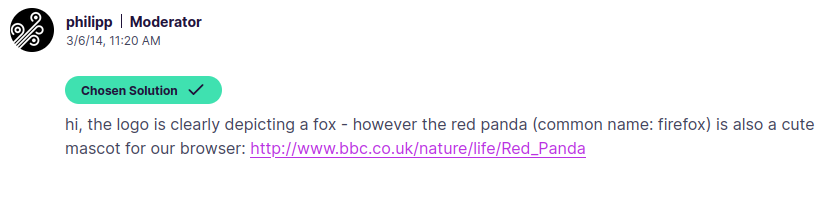
Cunning as a fox, and the official Mozilla support’s answer on this matter:
What exactly is your logo? A fox or a red panda?

Hi, the logo clearly depicts a fox — however, the red panda (common name: firefox) is also a cute mascot of our browser.
That turned out to be a short note. Thanks for reading. Good luck 😉
👨💻And…
Don’t forget about our Telegram channel 📱 and chat
Or maybe you want to become a co-author? Then click here🔗
💬 All the best ✌️
That should be it. If not, check the logs 🙂

Comments