
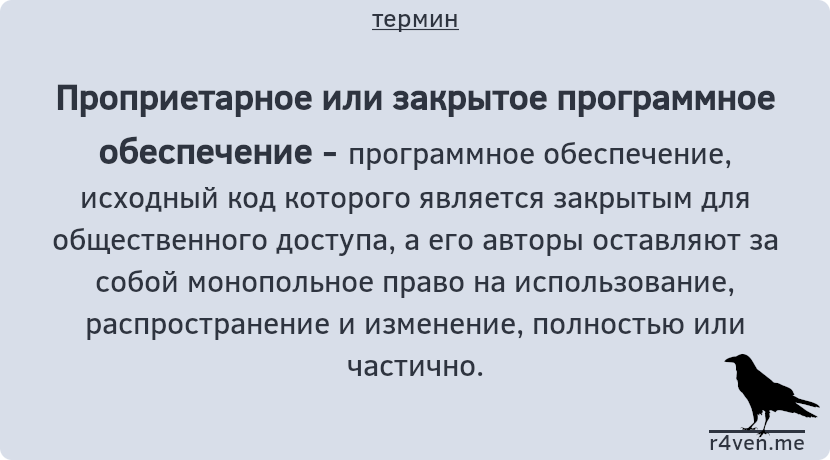
A vivid example of such software is the Windows operating system. Its source code is closed, protected by copyright, and this OS is distributed under a commercial license. The terms of use are usually described in detail in a multi-page user agreement (which nobody reads) before installation.
🖐️Hey!
Subscribe to our telegram @r4ven_me📱 to not miss new publications on the site😉. And if you have questions or want to chat about the topic — check out the Raven chat @r4ven_me_chat🧐.
This approach to developing and distributing programs, as often happens, has its own drawbacks and its own advantages. On one hand, in the case of a monopoly over software development, a certain integrity of the program is usually maintained, a specific idea and direction is followed, and the quality of the final product often depends on this.
Proprietary software is usually contrasted with open software. I’ve also written a note about it.

But the other side is complete uncertainty about the part of the program that is not its direct functionality. Since the source code is closed, specialists independent of the developer cannot even carry out a minimal audit of the parts of the program that interest them. This issue is especially acute regarding various kinds of telemetry (collection of user data). For example, Microsoft installs it very readily in its products, and a significant portion of their user agreement is devoted to this, which almost everyone thoughtlessly accepts by checking a box.
No one, except the developers themselves and the rights holders of the proprietary software, knows exactly what it might be doing in the background and without the user’s knowledge, what information the developer company is collecting, and what it does with that data. In my opinion, this is a significant downside of such software for the end user, though the user usually gives it little thought.
You can read more about the term on the Wikipedia page.

Comments