
We continue growing the Linux user’s glossary. Today we’ll talk about the term POSIX.
Wikipedia gives the following definition of this term:
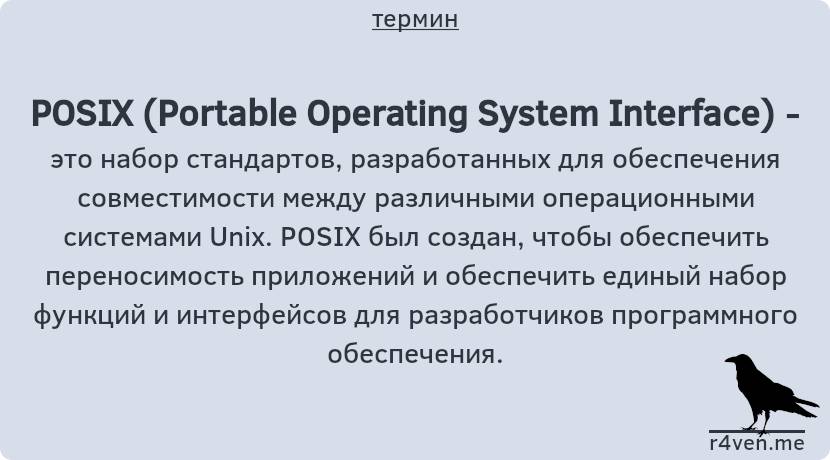
POSIX (Portable Operating System Interface) is a set of standards describing the interfaces between the operating system and an application program (system API), the C language library, and a set of applications and their interfaces. The standard was created to ensure compatibility between various UNIX-like operating systems and portability of application programs at the source code level, but it can also be used for non-Unix systems.
🖐️Hey!
Subscribe to our Telegram channel @r4ven_me📱, so you don’t miss new posts on the website 😉. If you have questions or just want to chat about the topic, feel free to join the Raven chat at @r4ven_me_chat🧐.
To better understand what this set of standards is, here are some examples implemented in accordance with the POSIX standard.
Programs:
- GNU Core Utilities (e.g., ls, cp, mv, rm) — the basic command-line utilities in Unix-like systems.
- GNU Compiler Collection (GCC) — a compiler for the C, C++, Fortran, and other programming languages, compliant with the POSIX standard.
- Apache HTTP Server — a popular web server that supports many POSIX features.
- OpenSSH — a set of programs for secure remote work with computers over the SSH (Secure Shell) protocol, which also comply with the POSIX standard.
Protocols:
- TCP/IP — the standard network protocol used in Unix-like systems and compliant with the POSIX standard.
- FTP (File Transfer Protocol) — a protocol for transferring files between computers, implemented in accordance with POSIX.
- HTTP (Hypertext Transfer Protocol) — a protocol for transferring web page data between client and server, which can be implemented in accordance with POSIX.
Libraries:
- POSIX Threads (pthreads) — the standard library for multithreaded programming in Unix-like systems.
- POSIX File I/O — a library for working with files and directories, compliant with the POSIX standard.
- POSIX Regular Expressions — a library for working with regular expressions in accordance with POSIX.
Command interpreters:
- Bash (Bourne Again SHell) — one of the most popular command interpreters in Unix-like systems, compliant with the POSIX standard (when using the
--posixflag). - KornShell (ksh) — a command interpreter compatible with POSIX that extends the capabilities of the standard sh interpreter.
These are just some examples of programs, protocols, libraries, and command interpreters that comply with the POSIX standard. There are many other tools and implementations supporting POSIX that help developers create portable software for Unix-like systems.
Useful sources
👨💻And…
Don’t forget about our Telegram channel 📱 and chat
Or maybe you want to become a co-author? Then click here🔗
💬 All the best ✌️
That should be it. If not, check the logs 🙂

Comments