
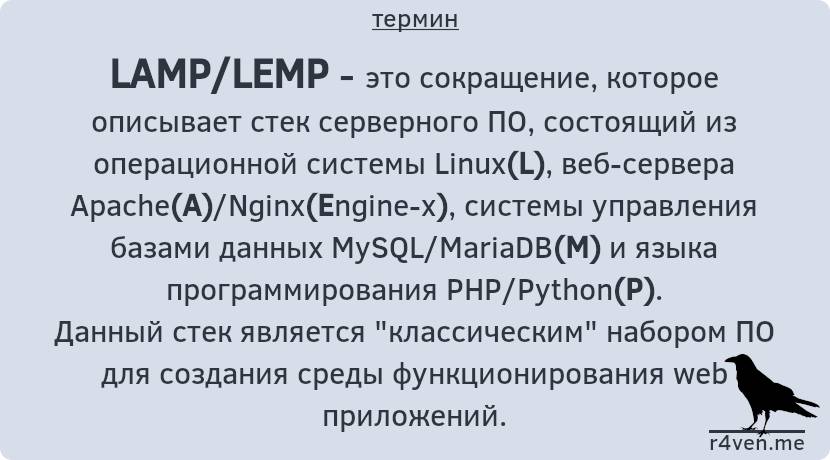
Today a new term is added to our Linux user’s glossary — LAMP or LEMP server.
🖐️Hey!
Subscribe to our Telegram channel @r4ven_me📱, so you don’t miss new posts on the website 😉. If you have questions or just want to chat about the topic, feel free to join the Raven chat at @r4ven_me_chat🧐.
If you’re starting to learn Linux and have encountered the “internals” of web technologies in any way, you’ve most likely heard of the LAMP/LEMP server. LAMP or LEMP is an abbreviation that denotes a server software stack often used for setting up websites and applications.
LAMP/LEMP includes the following components:
- Linux (L) — operating system. In the LAMP stack, Linux is the operating system that provides the basic infrastructure for the server to run. Linux provides stability, security, and many tools for server administration.
- Apache (A) or Nginx (E ngine-x**)** — web server. Apache is one of the most popular web servers in the world. It is responsible for processing requests from clients (web browsers) and sending web pages and data back to clients. Apache also supports many extensions and modules to expand its functionality. Nginx is also a very popular, high-performance, and lightweight web server. It is known for its performance and ability to efficiently handle heavy loads.
- MySQL or MariaDB (M) — database management system. MySQL/MariaDB is a relational database management system (RDBMS) used for storing data, such as user information, website content, and much more. It provides efficient storage and fast access to data.
- PHP or Python (P) — programming language. PHP and Python are scripting programming languages that allow creating dynamic web pages, web applications, and other backend functionality. They are often used to interact with MySQL/MariaDB databases (in the case of the LAMP\LEMP stack) and to generate content on websites.
The LAMP/LEMP server is today a classic and well-established set of software for working with web technologies. This is just a basic model, which often undergoes additions/extensions of functionality with the help of other programs and services. In any case, this should give you a general idea of what it is and how it works)
Thanks for reading. Good luck!
👨💻And…
Don’t forget about our Telegram channel 📱 and chat
Or maybe you want to become a co-author? Then click here🔗
💬 All the best ✌️
That should be it. If not, check the logs 🙂

Comments