
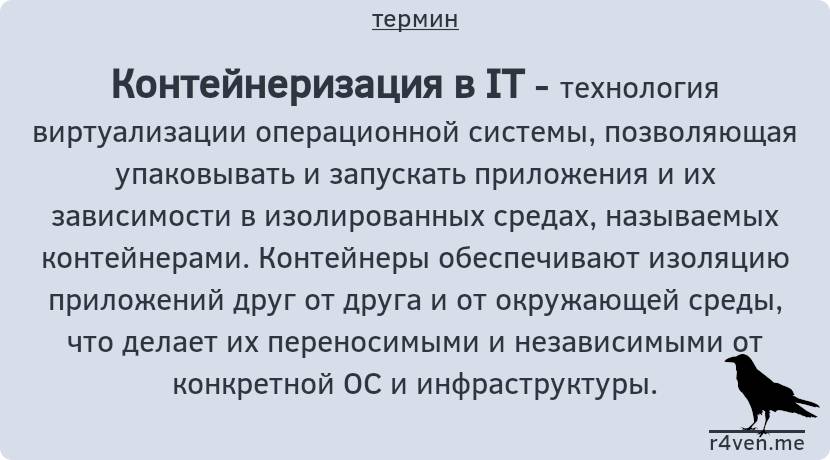
Today in the Linux user’s glossary, a popular term nowadays — containerization. What it is, what implementations exist, and briefly about the advantages and disadvantages.
🖐️Hey!
Subscribe to our Telegram channel @r4ven_me📱, so you don’t miss new posts on the website 😉. If you have questions or just want to chat about the topic, feel free to join the Raven chat at @r4ven_me_chat🧐.
Definition
Let’s hear what definition of this technology wiki gives:
Containerization (operating-system-level virtualization, container virtualization, zone virtualization) is a virtualization method in which the operating system kernel supports multiple isolated user-space instances instead of just one.
These instances (usually called containers or zones) are, from the point of view of the processes running in them, identical to a separate operating system instance. For Unix-based systems, this technology is similar to an improved implementation of the chroot mechanism. The kernel ensures complete isolation of containers, so programs from different containers cannot affect each other.
Wikipedia
You couldn’t say it better)
Previously I had two glossary entries on the site: Hypervisor – Virtualization Software and Virtual Machine. They discuss a different type of virtualization — hardware.
Containerization and hardware virtualization are two different approaches to virtualization in IT. While hardware virtualization emulates a complete hardware environment and allows running different operating systems on virtual machines, containerization works differently. Containers use a shared kernel with the host OS, which avoids emulating virtual hardware and running full copies of the OS. This approach allows for more economical use of server resources, unlike hardware virtualization.
Advantages and Disadvantages of Both Types of Technology
Hardware Virtualization
Advantages:
- isolation: virtual machines are completely isolated from each other, which increases system security and stability;
- support for various OSes: allows running different operating systems on a single physical server;
- full virtualization: each virtual machine has its own virtual hardware set.
Disadvantages:
- high overhead: using full virtualization requires significant system resources;
- slow boot: booting virtual machines can take longer due to the need to emulate hardware.
Containerization
Advantages:
- lightweight: containers use a shared operating system kernel, making them lighter and faster to launch and run;
- efficient resource usage: containers consume fewer resources since they don’t require hardware emulation;
- fast deployment: containers can be quickly created and launched, which speeds up the process of developing and deploying applications.
Disadvantages:
- limited OS choice: only operating systems compatible with the host operating system can be run in containers;
- isolation: containers don’t provide complete isolation like virtual machines do, which can create security and application stability issues.
Popular “Container” Implementations
Today, the following software is most often used on Linux servers to implement container technologies:
Docker:
- a popular containerization platform that provides a simple and powerful way to package, deliver, and run applications in containers;
- Docker provides a broad set of tools for managing containers, creating images, and deploying applications.
Podman:
- Podman is an alternative to Docker designed for managing containers in a Linux environment;
- it provides capabilities similar to Docker, but doesn’t require a daemon to work, which provides greater security and performance.
LXC (Linux Containers):
- a platform for creating and managing containers based on Linux;
- unlike Docker and Podman, LXC provides lower-level access to containerization functions, allowing users to fine-tune containers more precisely.
Useful Sources
- Containerization — Wiki
- Hardware virtualization — Wiki
- Virtual Machine — Crow’s Blog
- Hypervisor – Virtualization Software — Crow’s Blog
- Docker — Wiki
- Podman — tproger.ru
- LXC — Wiki
👨💻And…
Don’t forget about our Telegram channel 📱 and chat
Or maybe you want to become a co-author? Then click here🔗
💬 All the best ✌️
That should be it. If not, check the logs 🙂

Comments