
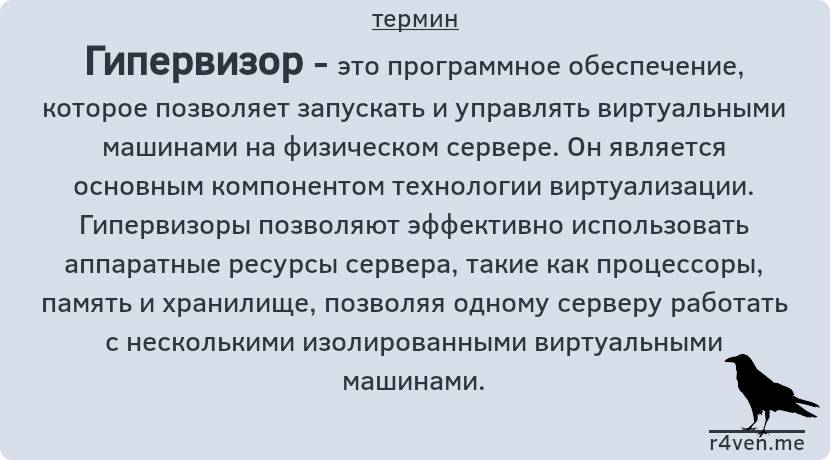
Today our Linux user’s glossary grows with a fairly popular term today — hypervisor.
Let’s hear what Wikipedia has to say on this topic:
A hypervisor, or virtual machine monitor, or low-level shell, is a program or hardware scheme that provides or allows the simultaneous, parallel execution of multiple operating systems on the same host computer. The hypervisor also provides isolation of operating systems from each other, protection and security, resource sharing between different running OSes, and resource management.
Hypervisors come in two types:
- Type 1 (bare-metal). Such a hypervisor, also known as “native” or “bare-metal,” runs directly at the hardware level of the server. It manages server resources and virtualizes them to run virtual machines. Examples of type 1 hypervisors include VMware ESXi, Microsoft Hyper-V, and Xen.
- Type 2 (hosted). Such a hypervisor runs on top of the host operating system and is an application that manages virtualization. It creates virtual machines as regular programs running within the operating system. Examples of type 2 hypervisors include VMware Workstation, Oracle VirtualBox, and KVM.
Join our channel: t.me/r4ven_me and chat: t.me/r4ven_me_chat on Telegram.
Hypervisors are widely used in cloud computing, server virtualization, and software testing, as well as in other situations where resource sharing and isolation between different operating systems and applications is required.
Here are a few examples of popular hypervisor implementations:
- KVM: KVM (Kernel-based Virtual Machine) is a type 2 hypervisor built into the Linux kernel. It uses hardware-based virtualization and allows running virtual machines on servers running Linux.
- Oracle VirtualBox: VirtualBox is a type 2 hypervisor developed by Oracle. It provides a virtualization environment for desktop computers and supports various operating systems, including Windows, Linux, macOS, and others.
- VMware ESXi: ESXi is a type 1 hypervisor developed by VMware. It provides a powerful platform for server virtualization, supports a wide range of operating systems, and offers many capabilities for managing virtual machines.
- Microsoft Hyper-V: Hyper-V is a hypervisor from Microsoft, which also belongs to type 1. It is included in Windows Server and provides an environment for server virtualization, as well as supporting network virtualization and resource management features.
- Xen: Xen is an open-source type 1 hypervisor. It is widely used in cloud computing infrastructure and offers powerful virtualization capabilities, such as resource scheduling and memory management.
These are just a few examples of popular hypervisors available on the market. Each of them has its own features, functionality, and is suited for different use cases.
By the way, we’re already familiar with the hypervisor from Oracle — VirtualBox. We installed it on Windows in the post: Try Linux right in Windows.
In the next post, we’ll install VirtualBox on Linux Mint. Don’t miss it) Good luck!
To read:
👨💻And…
Don’t forget about our Telegram channel 📱 and chat
Or maybe you want to become a co-author? Then click here🔗
💬 All the best ✌️
That should be it. If not, check the logs 🙂

Comments