
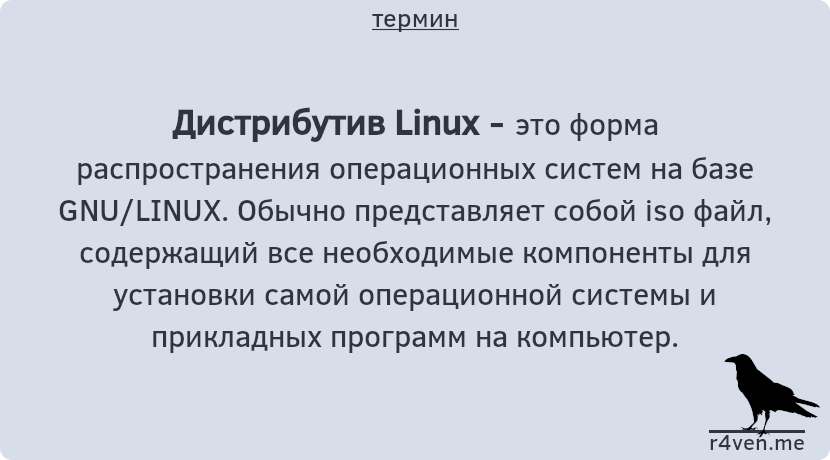
There is a great multitude of Linux distributions. Such a number is primarily due to the philosophy and principles of open software, which I wrote about earlier.
🖐️Hey!
Subscribe to our telegram @r4ven_me📱 to not miss new publications on the site😉. And if you have questions or want to chat about the topic — check out the Raven chat @r4ven_me_chat🧐.
There is a simple truth: a lot doesn’t mean quality. In this case, a lot doesn’t mean that all distributions are of good quality. After all, anyone can create their own. But there is a number of the most popular distributions, which represent a complete, working product, and serve as the basis for many others. The list of such representatives won’t be too long:
- Debian GNU/LINUX
- Red Hat Enterprise Linux (RHEL)
- Arch Linux
- Slackware
- Android (yes, it runs on the Linux kernel)
- others, less popular or little-known
And here is an approximate list of the most popular desktop distros based on the top three from the list above:
- Debian —> Ubuntu —> Linux Mint
- RHEL —> Fedora
—> Centos
—> OpenSUSE - Arch —> Manjaro
This is just a list of the most popular desktop distributions, in my opinion. In reality there are far more of them.
In the server segment, the list is roughly the same, except for Arch Linux. It is practically absent on servers, due to the concept behind its development (rolling release), which is not at all oriented toward permanence and stability. It might be used somewhere for running certain tests, but that’s more the exception.
Here is a detailed chart of the origins and relationships of distributions as of 2020. You could look at it for a whole hour. The newest distributions might not be included here.
If you want to take a closer look — click on the image. You’ll have to wait a bit, since the image is large and will take some time to load.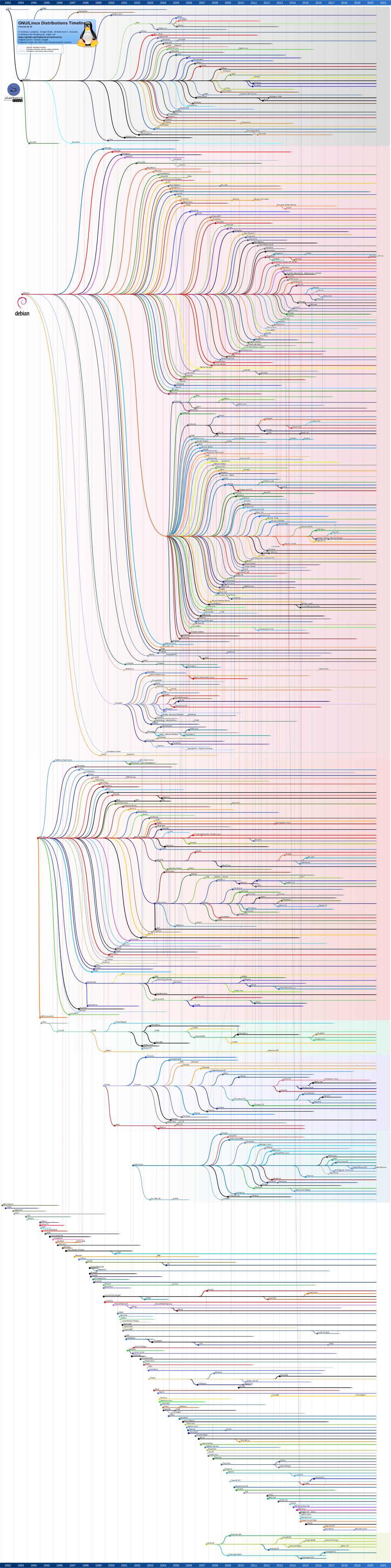

Comments